
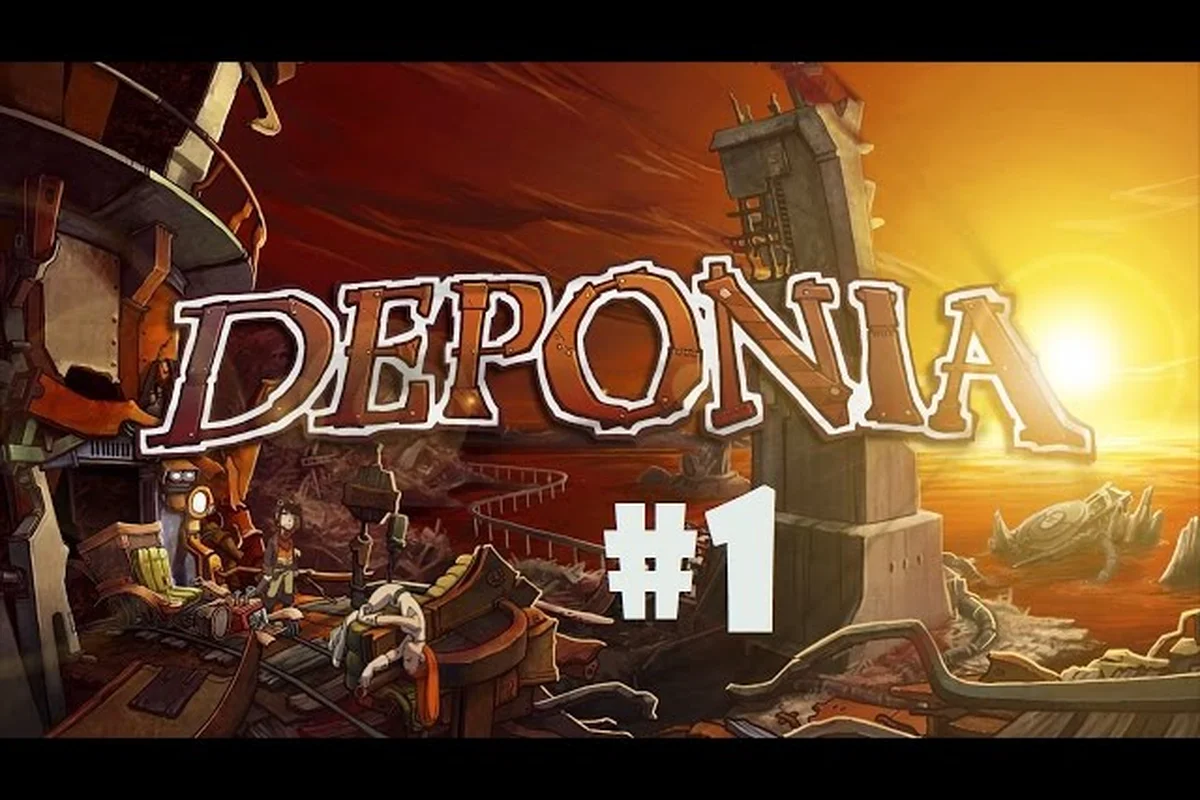
Deponia Rufus is one of the most memorable protagonists in modern point-and-click adventure gaming, and understanding his backstory explains why the entire trilogy works so well. Rufus is a young inventor from the junkyard town of Kuvaq on the trash-planet Deponia, and his single-minded obsession is escaping to the floating city of Elysium. Because he refuses to accept his miserable lot in life, he builds a makeshift rocket from scrap and junk, setting off a chain of events that reshapes his world forever. Getting to know Rufus — his goals, his flaws, and the people he drags into his schemes — gives you a much richer experience when you finally play through the series.
The core of Deponia Rufus lies in his personality: he is crotchety, scheming, endlessly funny, and completely convinced of his own genius despite overwhelming evidence to the contrary. According to the official Deponia page on Steam, he "ekes out a sorry existence" on a world reduced to a vast garbage dump, which perfectly captures the tone of the game. This article breaks down his rocket plan, his relationship with Goal, his rivalry with Cletus, and the supporting cast — Doc, Argus, and Ulysses — that makes his journey so chaotic.
Rufus and His Rocket Plan to Reach Elysium
Rufus's Rocket Mechanics: The Kuvaq Launch Sequence
Rufus's makeshift rocket in Kuvaq isn't a single-stage vessel but a patchwork of scavenged Deponia scrap. The launch sequence requires a specific ignition order: first, the boiler must reach critical pressure using compressed garbage gas, then the guidance fins—salvaged from a broken carnival ride—must be manually aligned. Failure to align the fins within the three-second window causes the rocket to veer sideways, dumping Rufus back into the trash heaps. This trial-and-error mechanic teaches players the game's core logic: every object on Deponia has a hidden, multi-step purpose before it can serve the main goal of reaching Elysium.
Cletus vs. Rufus: The Double's Strategic Advantage
Cletus, Goal's fiance, is an exact physical double for Rufus—a fact the game exploits for its central identity-swap puzzle. While Rufus is crotchety and impulsive, Cletus is calculating and aligned with the Organon. The key strategic difference lies in their social standing: Cletus can access Elysian facilities and Organon-controlled zones that Rufus cannot. Advanced players use this by deliberately getting Rufus mistaken for Cletus in Kuvaq, triggering dialogue trees that reveal Organon patrol routes. Bailiff Argus's pursuit of Goal becomes easier to evade once players learn to bait Argus into chasing the wrong double, buying critical time for Doc's implant repairs.
Rufus spends his days on Deponia dreaming of Elysium, the pristine floating city where the wealthy live in comfort while the rest of humanity sorts through garbage below. His grand scheme involves building a makeshift rocket from salvaged parts, and while the plan is absurdly impractical, it reveals everything about his character: he is resourceful, determined, and utterly reckless. The rocket itself is a patchwork of scrap metal, old engines, and whatever else he can scavenge from the junkyard, which is exactly the kind of engineering you would expect from someone who has never received formal training.
What makes the rocket plan so compelling is that it actually works — at least long enough to change his life forever. When Rufus launches himself toward Elysium, he accidentally knocks Goal, an Elysian woman, out of the sky, and she crashes down onto Deponia with a damaged brain implant. This single accident transforms his simple escape fantasy into a much larger responsibility, because Goal carries critical information that the ruling powers desperately want to suppress. The rocket plan, which was supposed to be his ticket out, instead becomes the catalyst for a trilogy-spanning adventure.
| Rocket Plan Element | What Rufus Does | What Goes Wrong |
|---|---|---|
| Launch Vehicle | Builds a scrap-metal rocket from junkyard parts | Crashes shortly after takeoff |
| Target Destination | Aims for the floating city of Elysium | Knocks Goal out of the sky instead |
| Power Source | Uses salvaged engines and improvised fuel | Explodes at the worst possible moment |
| Backup Plan | Has no real backup plan | Everything depends on Goal's cooperation |
| Final Outcome | Reaches Elysium eventually, but not as planned | His journey takes four full games |
The rocket plan also establishes the central irony of Rufus's character: he is convinced he is a genius, but his schemes consistently backfire in spectacular ways. Rather than making him a frustrating protagonist, this flaw makes him deeply relatable, because his failures are always entertaining and his persistence never wavers. Players quickly learn that the joy of Deponia Rufus comes not from watching him succeed, but from watching him try, fail, and try again with increasingly absurd solutions.
Goal and the Elysian Connection
Goal's Implant Cartridge System: Memory Storage Mechanics
Goal's damaged brain implant operates on a cartridge-based memory system, storing Elysian memories in swappable modules. When she lands unconscious in Kuvaq, the impact dislodges three critical cartridges, each containing distinct data: one holds her identity, another her relationship with Cletus, and the third the Organon's access codes. Doc's repair sequence requires players to insert cartridges in the correct order—identity first, then relationship, then codes—or Goal experiences memory fragmentation. This mechanic directly foreshadows Chaos on Deponia, where her consciousness splits into three parts, requiring Rufus to reunite them before venturing to Elysium. This mechanic directly foreshadows Chaos on Deponia, where her consciousness splits into three parts, requiring Rufus to reunite them before venturing to Elysium—a fragmentation that makes her arguably the most compelling figure in the series, which is why she tops our ranking of the Deponia Best Character.
Three Rufus Clones: Multi-Character Puzzle Solving
Goodbye Deponia's tagline—"Not one, not two, but three Rufuses"—introduces a cloning mechanic that fundamentally changes puzzle-solving. After stumbling upon the cloning machine, Rufus splits into three simultaneous instances, each assigned a distinct objective: find Goal, reach Elysium, and prevent Deponia's destruction. The player controls all three clones together, meaning puzzles require parallel coordination rather than sequential action. For example, one clone must hold a lever open while another navigates a collapsing platform and the third distracts Organon guards. This tri-clone system escalates the first game's single-character logic, demanding players track three inventory sets and three dialogue branches simultaneously for the first time in the series.
Goal is the Elysian woman whose arrival on Deponia completely derails Rufus's original escape plan, and she becomes the emotional anchor of the entire trilogy. After Rufus rescues her from the crash, she lands unconscious in Kuvaq with a damaged brain implant — a cartridge system that stores Elysian memories and knowledge. Because her implant is broken, she cannot remember who she is or why she was falling toward Deponia, which forces Rufus to take responsibility for her recovery.
The relationship between Rufus and Goal is complicated by the fact that she is engaged to Cletus, an Elysian who happens to be Rufus's exact double. This coincidence drives much of the plot, because Cletus is secretly plotting with the Organon to wipe Goal's memory after extracting the codes stored in her implant. Rufus, who initially sees Goal as a ticket to Elysium, gradually develops genuine feelings for her, even though he constantly claims his motives are purely selfish.
| Goal's Character Trait | How It Affects Rufus | Story Impact |
|---|---|---|
| Amnesia from damaged implant | Forces Rufus to explain Deponia to her | Creates constant comedy and tension |
| Elysian upbringing | She is horrified by Deponia's conditions | Highlights the class divide |
| Stored memory cartridges | Contains vital codes the Organon wants | Makes her a target throughout the trilogy |
| Engagement to Cletus | Rufus impersonates Cletus repeatedly | Drives the central conflict |
| Growing bond with Rufus | Complicates her loyalty to Elysium | Sets up the emotional finale |
Because Goal's memories are stored in a cartridge system, Doc — the travelling maintenance man — becomes essential to the plot. Doc repairs Goal's implants and helps restore her fragmented memories, though his methods are as unconventional as everything else on Deponia. The dynamic between Rufus, Goal, and Doc creates some of the funniest moments in the series, because Doc treats brain surgery with the same casual attitude that Rufus applies to rocket engineering.
Cletus, the Organon, and the Conspiracy
Cletus is Goal's fiancé and Rufus's exact double, which makes him both a rival and an unexpected asset. While Rufus is scruffy, impulsive, and perpetually scheming, Cletus is polished, calculating, and deeply entrenched in Elysian society. The visual similarity between the two characters is played for constant comedy, but it also serves a narrative purpose: Rufus can impersonate Cletus to infiltrate Elysium, while Cletus can frame Rufus for crimes he never committed.
The Organon is the militant organization that governs Elysium and maintains the strict separation between the floating city and the garbage planet below. Led by Prime Controller Ulysses, the Organon plans to destroy Deponia entirely, erasing all evidence that the lower class ever existed. This conspiracy is the driving force behind the trilogy's plot, because Goal accidentally discovered the truth and was trying to expose it when she fell from the sky.
| Organon Member | Role in the Conspiracy | Relationship to Rufus |
|---|---|---|
| Prime Controller Ulysses | Leads the Organon and orders Deponia's destruction | The ultimate antagonist |
| Bailiff Argus | Pursues Goal to recover her implant codes | Relentless tracker and fighter |
| Cletus | Plots to wipe Goal's memory for the Organon | Rufus's double and romantic rival |
| Organon Troopers | Enforce Elysium's laws on Deponia | Obstacles in every chapter |
Bailiff Argus deserves special attention because he serves as the trilogy's most persistent threat. Unlike the bumbling troopers who chase Rufus through Kuvaq, Argus is competent, determined, and genuinely dangerous. His pursuit of Goal forces Rufus to stay one step ahead at all times, which creates the tension that balances the game's comedy. According to community reports, Argus becomes more sympathetic in later games as players learn more about his motivations, but he remains a formidable antagonist throughout.
Doc, Captain Bozo, and the Supporting Cast
The supporting cast around Deponia Rufus is what elevates the series from a simple adventure game to a genuinely memorable comedy. Doc is the travelling maintenance man who repairs Goal's implants, and his unorthodox approach to medicine provides some of the trilogy's best jokes. Because Doc treats every procedure as a casual repair job, his scenes with Goal are both hilarious and surprisingly touching, as he genuinely wants to help her recover.
Captain Bozo runs the trawler that helps Rufus leave Deponia, and his gruff exterior hides a surprisingly helpful nature. While Bozo initially seems like just another obstacle, he becomes an essential ally in Rufus's journey, providing transportation and occasional wisdom. The relationship between Rufus and Bozo is built on mutual distrust that slowly evolves into grudging respect, which mirrors the overall tone of the series.
The supporting cast also includes Toni, a friend of Rufus introduced in the sequels, whose presence adds emotional depth to the later games. According to community-sourced details, Toni represents the life Rufus could have had if he had stayed on Deponia and accepted his circumstances, which makes her scenes particularly poignant. The contrast between Toni's grounded practicality and Rufus's wild ambition highlights the central theme of the trilogy: is it better to dream of something better, or to make peace with what you have?
| Supporting Character | Role in the Story | Memorable Trait |
|---|---|---|
| Doc | Repairs Goal's brain implant | Casual approach to brain surgery |
| Captain Bozo | Provides transportation off Deponia | Gruff but reliable ally |
| Toni | Friend from Kuvaq introduced in sequels | Represents the life Rufus left behind |
| Wenzel | Local merchant and occasional ally | Always has a deal to offer |
Rufus Clones and the Chaos of Goodbye Deponia
By the time the trilogy reaches Goodbye Deponia, Rufus's schemes have escalated to the point where one copy of him is no longer enough. After stumbling upon a cloning machine, Rufus clones himself to solve three problems simultaneously: find Goal, reach Elysium, and prevent Deponia's destruction. The game's tagline — "More chaos, more destruction, more Rufus. Not one, not two, but three Rufuses" — perfectly captures the absurdity of the situation, and players control all three clones together throughout the adventure.
The cloning mechanic creates some of the most creative puzzle design in the series, because each Rufus clone can work independently while the player switches between them. This allows for simultaneous problem-solving that would be impossible with a single character, and it also amplifies the comedy by putting three versions of Rufus's personality in conflict with each other. Because each clone shares the same flawed logic and overconfidence, their interactions are predictably chaotic.
| Clone | Primary Objective | Personality Quirk |
|---|---|---|
| Clone 1 | Find Goal | Most focused on the mission |
| Clone 2 | Reach Elysium | Most obsessed with escape |
| Clone 3 | Prevent Deponia's destruction | Most concerned about consequences |
The cloning arc also serves as a commentary on Rufus's character growth throughout the series. In the first game, he is purely selfish, using Goal as a means to reach Elysium. By the time he clones himself, he is trying to save everyone and everything at once, which shows how much he has changed. The fact that he needs three copies of himself to handle his responsibilities is both a joke and a genuine character development, because it proves he has finally accepted that his actions have consequences.
Frequently Asked Questions
How old is Rufus in Deponia?
Rufus is a young adult, though the game never states his exact age. Based on his behavior, appearance, and the way other characters treat him, most players estimate he is in his early to mid-twenties. His youth explains both his reckless optimism and his refusal to accept life on Deponia as permanent.
Why does Rufus want to go to Elysium?
Rufus wants to escape the junkyard planet Deponia because he believes he deserves a better life. Elysium represents wealth, comfort, and respect — everything he lacks in Kuvaq. His obsession with reaching the floating city drives the entire trilogy, even as his reasons for leaving evolve from pure selfishness to genuine concern for Goal and Deponia.
Is Cletus actually Rufus's twin?
No, Cletus is not related to Rufus, but they are exact physical doubles. This coincidence is never fully explained, though it drives much of the plot. Rufus uses the resemblance to impersonate Cletus and infiltrate Elysium, while Cletus uses it to frame Rufus for his own schemes.
What happens to Goal's memories in the trilogy?
Goal's memories are stored in a cartridge system connected to her brain implant, which was damaged when she crashed on Deponia. Doc repairs the implant and helps restore her memories gradually throughout the series. The codes stored in her memories are what the Organon wants to recover, making her a target from the first game onward.
Does Rufus ever reach Elysium?
Yes, Rufus reaches Elysium, but only after four games of schemes and chaos. His original rocket plan fails, forcing him through Cletus's conspiracy, Goal's split consciousness, and cloning himself into three Rufuses in Goodbye Deponia. By arrival, reaching Elysium feels less like victory than the journey he endured.